

Do Sex Hormones Matter When It Comes to Your Performance? Here We Go Again
In 2024 I wrote a blog: Understanding The Menstrual Cycle and Its impact on Sport Performance…Does it Really Matter? The conclusion of the blog was written as such:
“Understanding your menstrual cycle and how it may impact your body could be a factor that helps support your performance and well-being.
While current research offers mixed and low-quality evidence, it’s still valuable to tune into how you personally feel throughout your cycle. By paying attention to these natural rhythms and adjusting your training according to how you feel, you can harness your body’s strengths and manage its challenges.
Remember, every athlete is different, so let your cycle be one of many guides to training, rest, and recovery.”
Two years later… has anything changed?
The short answer: not really—but also, yes.
The idea that your symptoms play a larger role in performance than your sex hormones alone hasn’t changed. What has changed is the strength of the evidence supporting that idea.
And if I’m being honest, my recommendations have shifted slightly too—to better reflect that evidence. (Because in this field, if you aren’t changing what you do, you aren’t learning.)
So let’s talk about it and update those training recommendations.
Quick Recap: What is Your Menstrual Cycle?
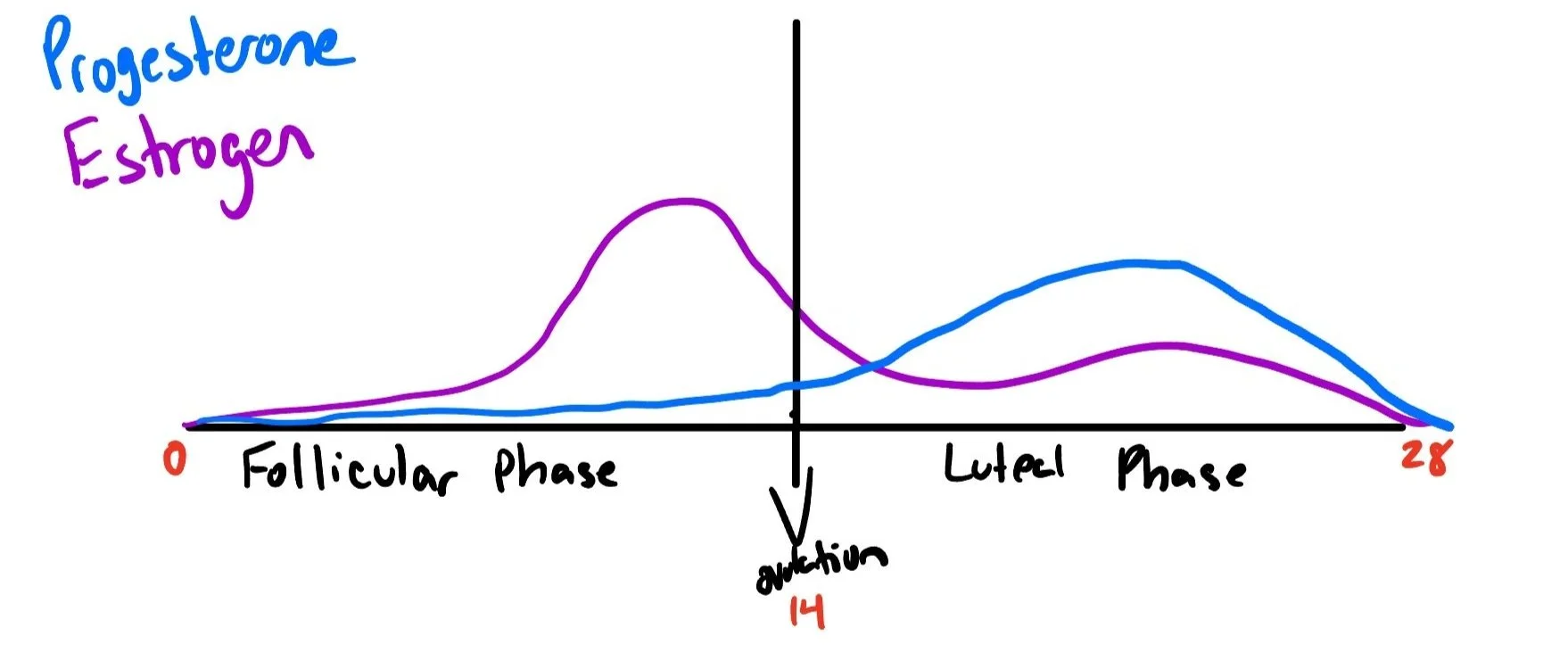
The image above shows an example of menstrual cycle length, but it can slightly vary from person to person.
Your menstrual cycle starts with your follicular phase on the first day of your period, when both estrogen and progesterone are at their lowest.
Ovulation typically occurs around 14 days after the start of your cycle (though this can vary). As ovulation approaches, estrogen rises and eventually peaks. During this time, your body releases an egg for potential fertilization.
From here, one of two things happens:
The egg is fertilized → pregnancy occurs
The egg is not fertilized
The luteal phase follows ovulation and prepares the uterus to support a fertilized egg. During this phase, progesterone rises and estrogen increases slightly as well.
If fertilization does not occur, both hormones drop, the uterine lining sheds, and the cycle begins again.
Update Recommendations from my 2024 blog:
Follicular Phase
Early Follicular Phase (Period Days 1-6):
What You Might Feel: Tired, uncomfortable, and distracted by cramps or fear of leaking. Poor concentration or fear due to low serotonin levels. You may feel no symptoms or the opposite.
Hormone Levels: Both estrogen and progesterone are low.
Training tips if you are experiencing symptoms: Prioritize recovery strategies (nutrition (>45kcal/kg FFM/day) and sleep), pain management (NSAIDs, movement, see a healthcare provider if experiencing symptoms from diagnosis like: Premenstrual Dysphoric Disorder (PMDD), PCOS, Endometriosis, etc), mental focus practices (breath work). Take appropriate rests between climb attempts or end sessions when power output feels down.
Late Follicular Phase:
What You Might Feel: Upswing in energy and focus. Strength and power might feel more accessible/favorable. You may feel no changes or the opposite.
Hormone Levels: Estrogen is on the rise, while progesterone stays low.
Training tips if you are experiencing symptoms: Prioritize recovery strategies (nutrition (>45kcal/kg FFM/day) and sleep)(because we should always be doing this) End session when power output feels down (this feels smart to do as a common practice)
Ovulation (Around Day 14):
What You Might Feel: Strong, powerful, and focused. You may feel no changes or the opposite.
Hormone Levels: Estrogen peaks, with progesterone beginning to rise.
Training tips if you are experiencing symptoms: Prioritize recovery strategies (nutrition (>45kcal/kg FFM/day) and sleep)(because we should always be doing this) End session when power output feels down (this feels smart to do as a common practice)
Luteal Phase
Mid Luteal Phase:
What You Might Feel: Slight challenge in accessing strength and power. Increased hunger cues. You may feel no changes or the opposite.
Hormone Levels: Estrogen and progesterone levels are both up, with progesterone taking the lead.
Training Tips: Prioritize recovery strategies (nutrition (>45kcal/kg FFM/day) and sleep). Prioritize fueling for sessions (carbohydrates ~3-10g/kg/day and protein (1.4-2.2g/kg/day)). Take appropriate rests between climb attempts or end sessions when power output feels down.
Late Luteal Phase:
What You Might Feel: Fatigue might become more noticeable as well as mood disturbances. Increased hunger cues and cravings. GI discomfort, sleep disturbances, inflamation. You may feel no changes or the opposite.
Hormone Levels: Progesterone and estrogen starts to taper off.
Training tips if you are experiencing symptoms: Prioritize recovery strategies (nutrition (>45kcal/kg FFM/day) and sleep). Prioritize fueling for sessions (carbohydrates ~3-10g/kg/day and protein (1.4-2.2g/kg/day)). Work with a registered dietitian to help understand what foods are favorable for your GI system if experiencing symptoms. Take appropriate rests between climb attempts or end sessions when power output feels down.
My hope is that these recommendations are more inclusive to everyone who experiences a menstrual cycle and avoids placing anyone into a box.
The reality still ends up being that life is hard. Consistently prioritizing nutrition, sleep, and stress management is really hard to do, and sometimes we won’t be able to. Too often I see people push through and then get frustrated when they can’t access that feeling of strength and focus.
If you resonate with this, I recommend this: if you’re feeling cruddy at the gym and you have a sense your recovery is down, give yourself permission to lower the intensity of that session or even skip the day. It may provide you with enough recovery for your next session to feel great, no matter what menstrual phase you are in.
Just try it out.
Conclusion
We can confidently say that your individual symptoms may impact performance more than hormones alone. We even have evidence showing that variability in hormone levels (i.e. increased estrogen or progesterone) does not consistently translate to changes in symptoms. Your symptoms are more strongly influenced by your energy availability, training status, sleep, GI tolerance, total life stress, and individual experiences than they are by fluctuations in hormones.
This is all good news! We don’t have to be at the mercy of our menstrual cycles. We can start to address the factors that more strongly affect our symptoms and positively influence our perception of performance.
References:
McNulty KL, Elliott-Sale KJ, Dolan E, et al. The Effects of Menstrual Cycle Phase on Exercise Performance in Eumenorrheic Women: A Systematic Review and Meta-Analysis. Sports Med. 2020;50(10):1813-1827. doi:10.1007/s40279-020-01319-3
Natalucci V, Spinello G, Moro T, Pavei G, Boccia G, La Torre A, Bonato M. Menstrual Cycle and Hormonal Contraceptives in Female Athletes: Should Symptoms and Nutrition Matter More than Cycle Phase? A Narrative Review. Nutrients. 2026; 18(7):1144. https://doi.org/10.3390/nu18071144
Righi, I., & Barroso, R. Menstrual cycle phases affect recovery more than performance in trained cyclists. International Journal of Sports Science & Coaching, 2026. doi:10.1177/17479541251407281
Schlie J, Krassowski V, Schmidt A. Effects of menstrual cycle phases on athletic performance and related physiological outcomes: a systematic review of studies using high methodological standards. J Appl Physiol (1985). 2025;139(3):650-667. doi:10.1152/japplphysiol.00223.2025